The Decontaminatable Tablet That Changed Ebola Ward Record-Keeping
August 2026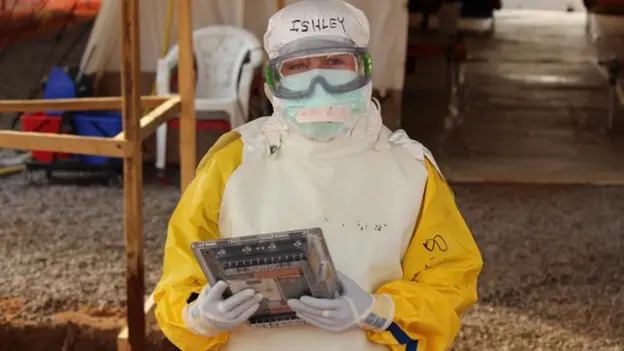
In Liberia's Ebola treatment units, the hardest part of care wasn't always medical. Sometimes it was the fence.
On one side, medical staff in full PPE worked inside the "hot zone," moving among patients whose lives depended on fast, accurate information. On the other side, a notetaker in the safe zone had to capture it all — gender, approximate age, what they were wearing, their symptoms. The only way to get that information across was to shout it, through a mask, across a barrier, patient after patient, and hope it landed correctly on paper.
It often didn't. PPE muffled voices. Details got lost or mixed up between patients. And the paper itself was a risk: the pen and clipboard passed hand to hand carried the same contamination the fence was built to prevent.
In 2015, AETRF's network helped design a different way in — a tablet built to be decontaminated and carried directly between the hot zone and the clean zone. Staff could enter a patient's information themselves, on the spot, in real time. No shouting. No hand-off. No paper trail carrying risk from one side of the fence to the other.
It's a small object with an outsized effect: fewer transcription errors, less transmission risk, more accurate records for the clinicians who needed them most.
This is what AETRF has always done — not abstract "tech for good," but specific tools solving specific, dangerous problems for the people closest to the crisis. The same instinct drives our work in the DRC today.